About Us

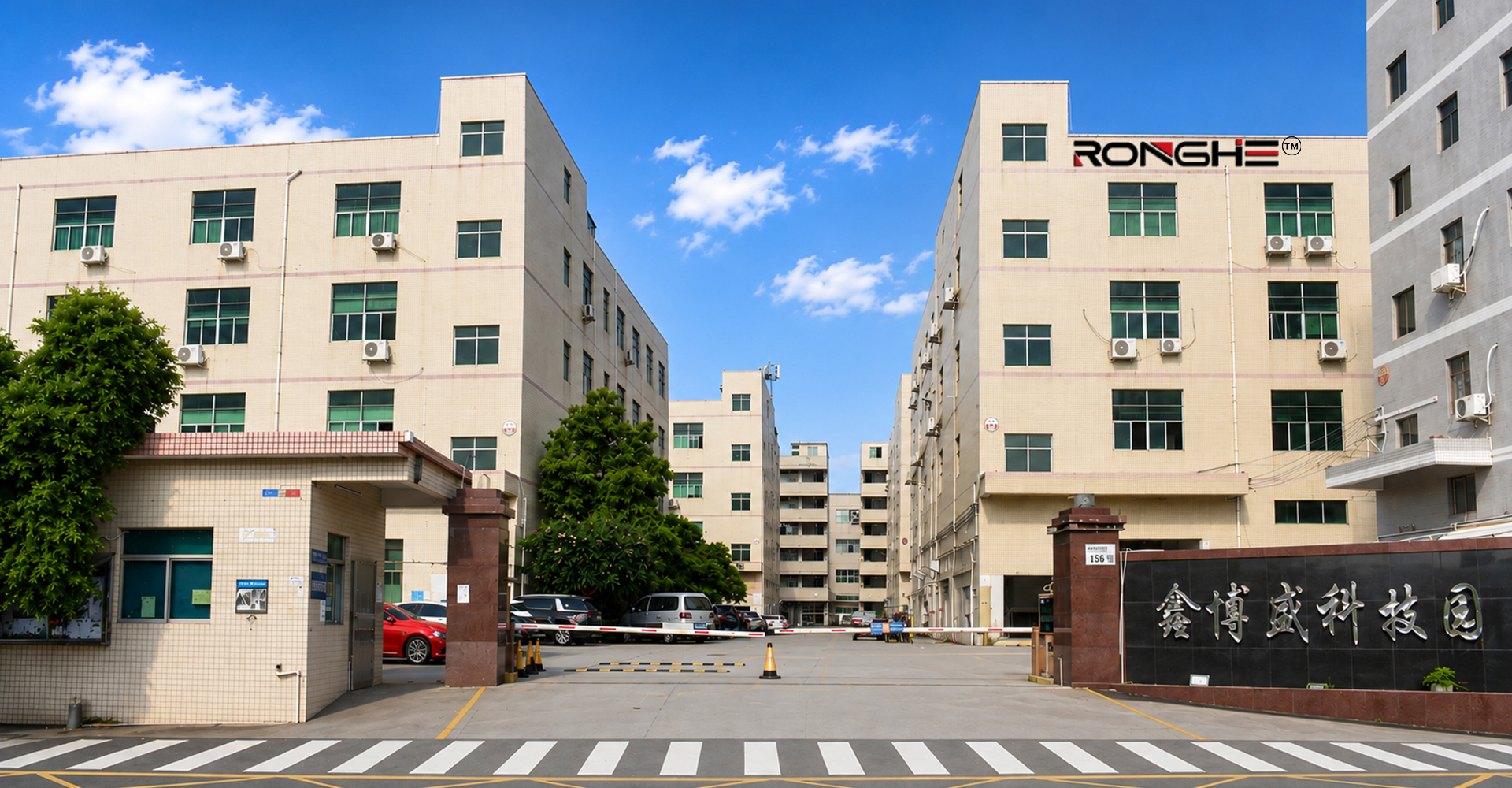
Shenzhen Ronghe Electronics Co., Ltd., established in 2017, is a National High-Tech Enterprise based in Shenzhen, China. Operating under the parent company brand ROHE, the company has developed specialized business divisions, including RONGHE, its dedicated PCB and PCBA manufacturing division.

Located at No. 156 Binhe East Road, Guangming New District, Shenzhen, the company operates its own smart manufacturing facility covering more than 3,500 square meters. Its workforce includes a 20-person R&D department, with 12 members possessing over a decade of industry-specific R&D experience, a 35-person marketing team, 26 quality management professionals, and a production team of more than 230 employees.

Rather than taking a broad, generalized approach to electronics manufacturing, we focus on three specialized business divisions. Guided by our strategy of combining technology with manufacturing, each division has its own dedicated R&D, sales, and operations teams to serve its respective markets.

Our Three Core Business Divisions

  • Display Backlight Division (ROHE) – Specializing in LCD and LED TV backlight solutions and related components.

  • Plant Lighting Division (ROHE) – Focusing on horticultural LED lighting solutions for commercial cultivation and controlled-environment agriculture.

  • Electronics Manufacturing Services (EMS) Division (RONGHE) – Specializing in custom PCB assembly, embedded control boards, and electronics manufacturing services.

While these three divisions share the manufacturing resources, supply chain, and quality management systems of the parent company, ROHE, they maintain dedicated teams for customer communication, product development, and project execution.

RONGHE, as the dedicated PCBA manufacturing division, focuses on custom control board manufacturing for robotics and motor control, UAV and flight control systems, smart home and IoT devices, industrial automation, and power and energy management applications.

In addition to supporting the electronics manufacturing needs of ROHE's own product divisions, RONGHE provides PCBA manufacturing services to external customers worldwide.

Our manufacturing services cover component sourcing, SMT assembly, through-hole assembly, firmware programming, functional testing, prototype production, pilot runs, and mass production.

Our Manufacturing Strength

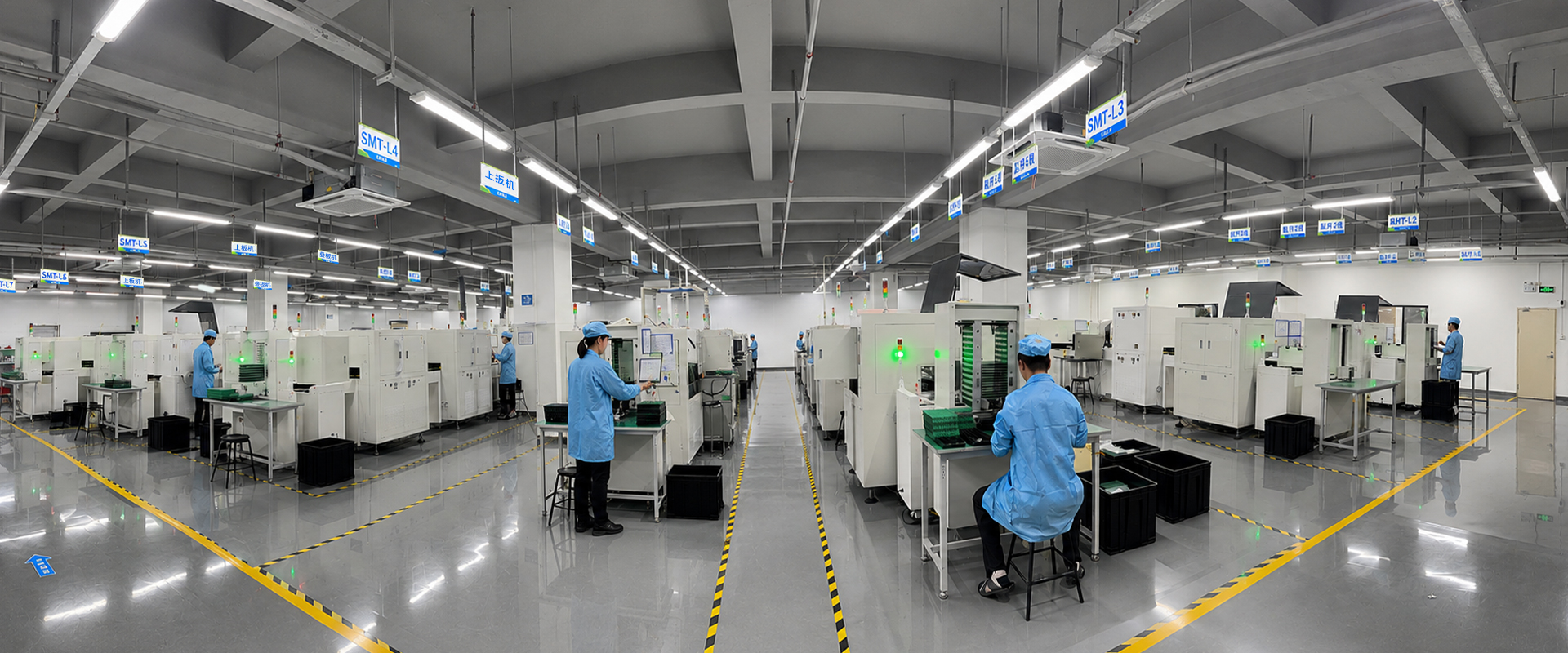
12 Production Lines | 7 SMT Lines + 5 Post-Soldering & Testing Lines

RONGHE's EMS Division operates within a 3,500-square-meter manufacturing facility in Shenzhen, China.

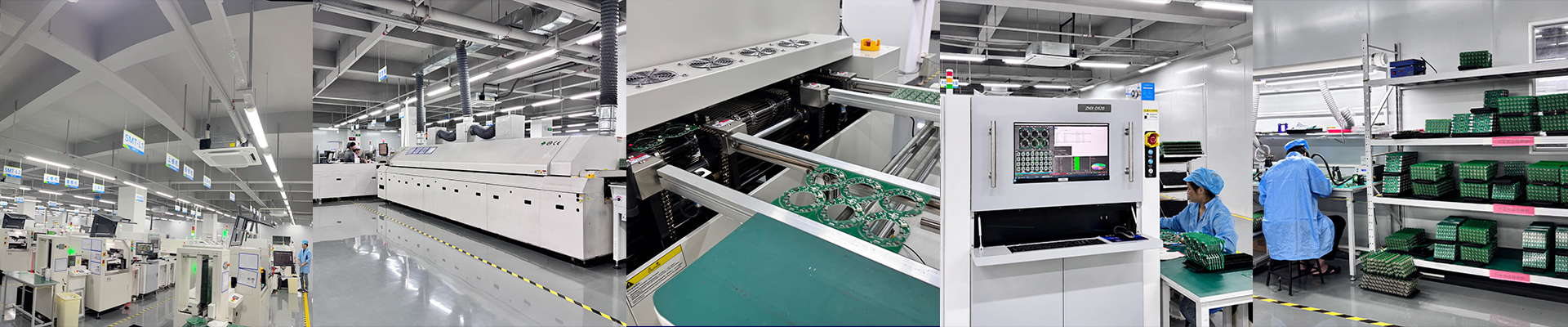
Our production facilities include 7 automated SMT assembly lines equipped with DEK automatic printers and SPI/AOI inspection systems, together with 5 post-soldering and testing lines.

With 12 production lines in total, RONGHE provides integrated PCBA manufacturing services, including component sourcing, SMT assembly, through-hole assembly, firmware programming, functional testing, and mass production.
🦾 AI Embodied Robot Joint Control

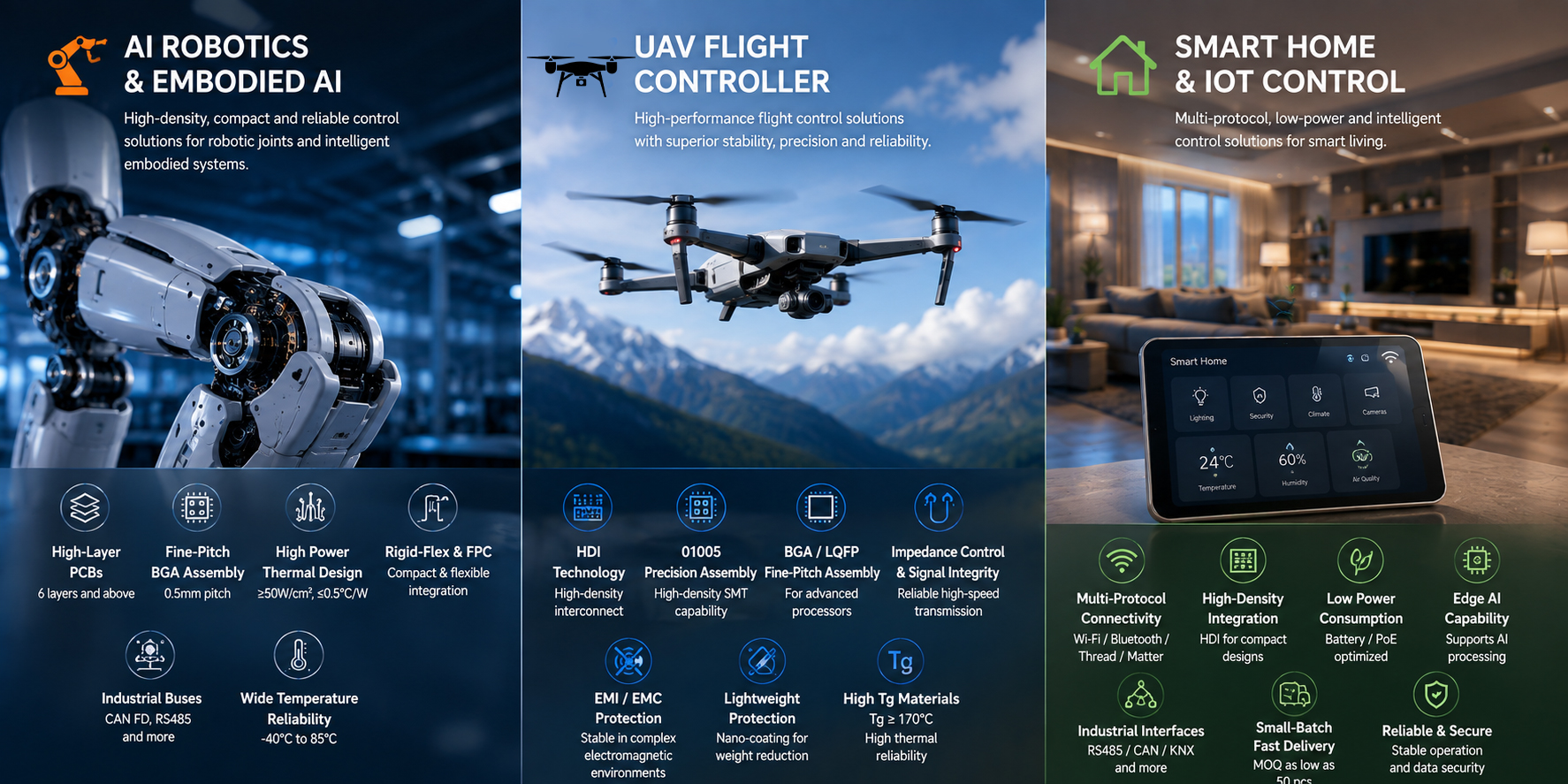
Humanoid robots require numerous distributed control boards (one for each limb or joint) in addition to a central computing unit. Joint spaces are extremely compact; PCBs typically measure only 40mm x 30mm with ultra-high component density (over 120 components on a single side), making thermal management the primary challenge. Joint control boards generally utilize a 6-layer (or higher) design, housing a main control MCU (BGA package, 0.5mm pitch), driver ICs, and current sensors. Additionally, rigid-flex boards and FPCs (Flexible Printed Circuits) are widely used to integrate cameras, sensors, and AI processors.

Ronghe’s EMS division offers:
Precision manufacturing capabilities for high-layer-count boards (6 layers and above) to meet the high-density routing requirements of robot joints
BGA assembly processes (0.5mm pitch) compatible with mainstream MCUs designed for robotics
High-power-density thermal design—achieving power densities ≥50W/cm² and thermal resistance ≤0.5°C/W through techniques such as thermal vias and copper thickness control
Manufacturing capabilities for rigid-flex boards and FPCs to accommodate the spatial constraints of moving parts like joints
Production of boards supporting industrial real-time bus communication interfaces such as CAN FD and RS485
Reliability assurance across a wide temperature range, suitable for all-weather robot operation scenarios

✈️ UAV Flight Control
The flight control board serves as the core control unit of a UAV, handling attitude estimation, sensor fusion, and the execution of flight algorithms. Flight control PCBAs must integrate dozens of components—including the main control chip, gyroscope, accelerometer, barometer, GPS module, and power management IC—within a space of 100x100mm or smaller. Main control chips typically utilize high-pin-count, fine-pitch BGA or LQFP packages. Flight control PCBs primarily handle high-speed signals, demanding rigorous impedance control, signal integrity, and EMI/EMC performance; they typically employ HDI (High-Density Interconnect) structures and micro-blind via designs. Industrial-grade flight control PCBs generally feature 6-8 layer (or higher) designs. Ronghe EMS Division capabilities include:

HDI (High-Density Interconnect) PCB manufacturing, enabling highly integrated routing within limited space
High-precision SMT placement (supporting 01005 micro-package components) to ensure high yields at extreme component densities
BGA/LQFP fine-pitch package placement processes, compatible with mainstream flight control processors
Impedance control and signal integrity assurance for reliable high-speed signal transmission
EMI/EMC design and manufacturing to meet the demands of complex drone electromagnetic environments
Lightweight protection processes (nano-coatings replacing traditional conformal coatings) to meet drone weight-reduction requirements
Selection of high-Tg materials (Tg ≥ 170°C) to ensure substrate stability and reliable via-wall plating strength in high-temperature environments

🏠 Smart Home Control
Smart home technology is evolving from standalone smart devices to whole-home intelligence. As the core of whole-home connectivity, central control panels must integrate multiple protocols—such as Wi-Fi, Bluetooth, Thread, and Matter—to enable interoperability across devices from different brands. Meanwhile, miniaturization, low power consumption, and edge AI capabilities have become key trends.
Our PCBA manufacturing capabilities for smart homes include:
Multi-RF integration—Coexistence and anti-interference design for multi-protocol wireless modules
High-density integration—HDI PCBs to meet miniaturization requirements
Low-power design—Power-saving modes and PoE (Power over Ethernet) solutions
Edge AI computing support—Compatibility with SoC platforms like Rockchip and support for Android/Linux systems
Industrial protocol support—Bus interfaces such as RS485, CAN, and KNX
Prototype & Small-Batch Manufacturing
We support prototype builds and small-batch production. Minimum order quantities are evaluated based on PCB design, component availability, assembly requirements and project specifications.
Core Manufacturing Capabilities
SMT Assembly: 7 automated SMT lines supporting 01005 micro-components, BGA, and PoP (Package-on-Package)
High-layer-count boards: Manufacturing capabilities for PCBs with 12 or more layers
Rigid-flex boards: Design and manufacturing of rigid-flex PCBs
HDI processes: Micro-blind/buried vias and laser drilling
Comprehensive quality control: AOI (Automated Optical Inspection), ICT (In-Circuit Testing), functional testing, and high/low-temperature aging tests
One-stop service: Solution design → PCB layout → Component procurement → SMT/DIP → Testing → Assembly and delivery


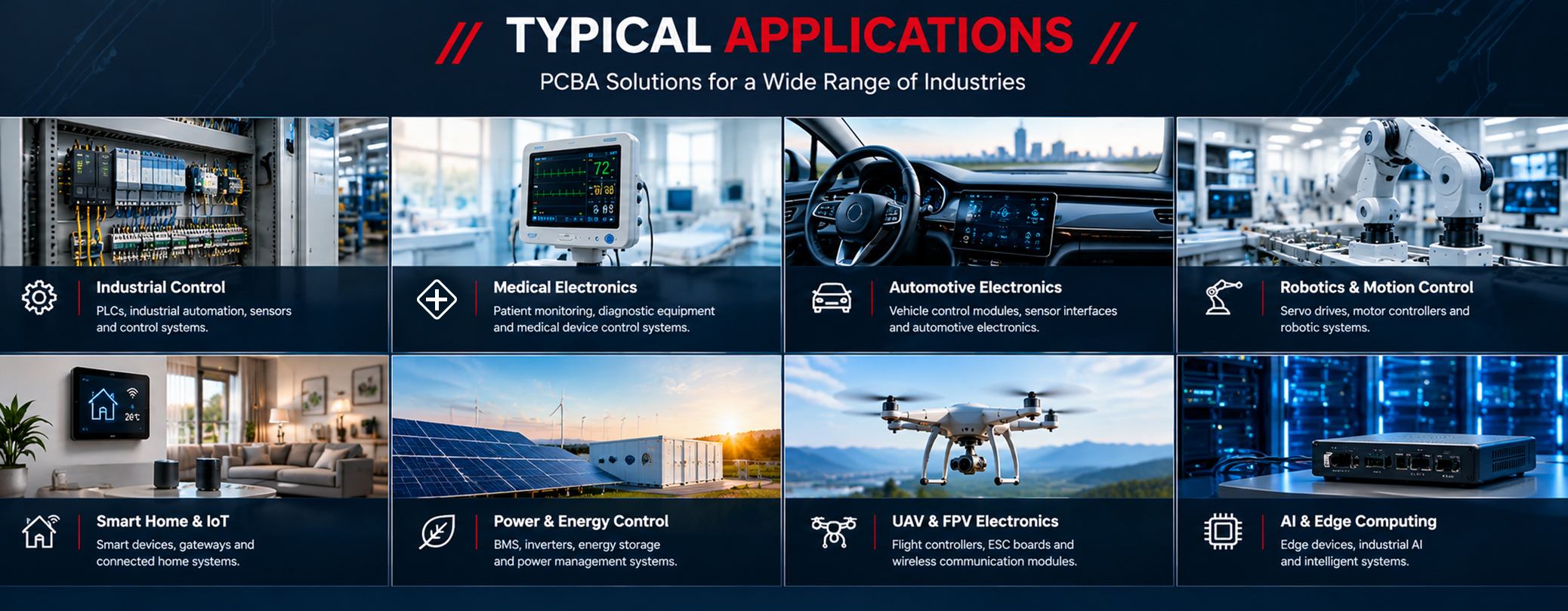
Typical Applications

Custom PCB Assembly & Electronics Manufacturing for Diverse Industries
RONGHE provides custom PCBA manufacturing services for industrial automation, medical electronics, automotive systems, robotics and motor control, smart home and IoT, power and energy management, UAV electronics, and AI edge computing.
From prototype development to volume production, we support hardware companies with component sourcing, SMT assembly, firmware programming, and functional testing.


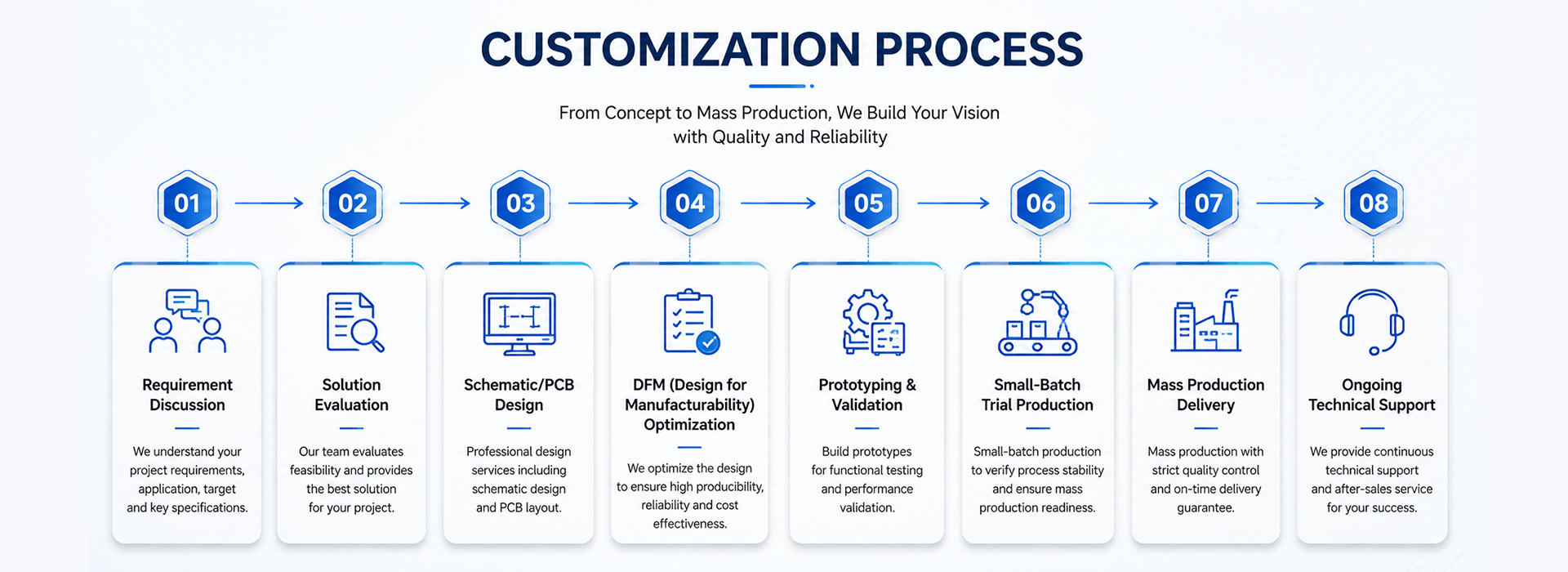
Customization Process

Requirement Discussion → Solution Evaluation → Schematic/PCB Design → DFM (Design for Manufacturability) Optimization → Prototyping & Validation → Small-Batch Trial Production → Mass Production Delivery → Ongoing Technical Support